

We are a Catholic family who loves, grows and lives in faith through Jesus Christ
Holy Trinity Catholic Church has a long and beautiful history, dating back to the founding of Lenexa, Kansas. Click the images below to walk through the rich history of our parish. We are fortunate to have a talented group of parish "historians" to assist us in keeping Holy Trinity's rich history memorially accurate. If you'd like to join them in this task, please contact Katie Pike at This email address is being protected from spambots. You need JavaScript enabled to view it..
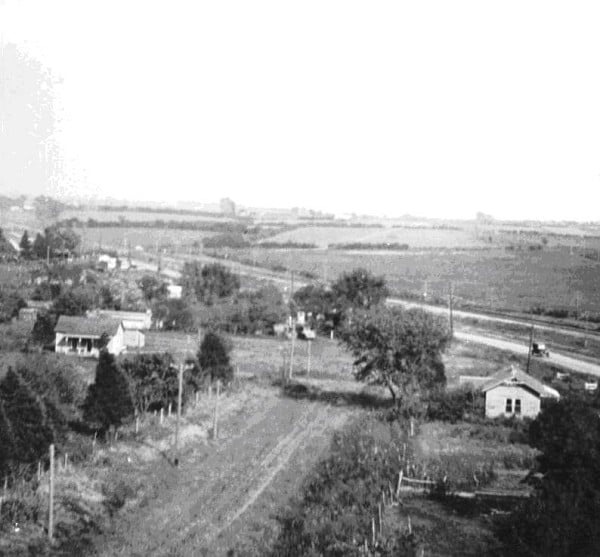 From 1868 until 1906, Holy Trinity was a mission parish of St. Joseph Church in Shawnee, Kansas - with the exception of one year, (1892-1893) when it was a mission of Eudora, Kansas.
On August 28, 1868 Rev. Henry Deusterman was the first resident pastor of St. Joseph’s Parish in Shawnee, Kansas. St. Joseph’s Parish served 1/3 of Johnson County, including what would be known in the future as Holy Trinity in Lenexa. Thirty people normally attended Mass each Sunday with the average collection being 45 cents. Fr. Deusterman traveled by horseback or horse and buggy to different locales in Johnson County. In the Lenexa area, Mass was offered in the home of Mr. and Mrs. Mathias Krumm, who settled in the area in 1864.
Rev. J. Pichler replaced Fr. Deusterman on April 1, 1873. Fr. Pichler and Fr. Deusterman were farmers out of necessity to augment the small income from the collection plates. Fr. Pichler built a two-story brick school and taught the children himself.
Holy Trinity is founded…
On July 16, 1876, Rev. Albert Weikmann became pastor, a post he held until 1884. In 1880, twenty Catholic families requested permission to form a parish. The request was granted and Holy Trinity was founded. The small community of Catholic families in Lenexa raised money through subscriptions, picnics, and dinners and purchased four lots at a cost of $160.00.
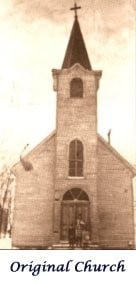 New White Frame Mission Church in 1882
A small white frame mission church was completed in 1882 at a cost of approximately $1200.00. This church was built where the current rectory now stands. Written in the Lenexa Parish Account by Fr. Weikmann are the words: “This place formed one Mission with Shawnee up to 1882. In 1881 Lenexa built its church and is tended once a month on Sunday since January 1, 1882.”
Fr. William Schellberg was pastor from 1884 to 1890. During this time, Mass was celebrated every other Sunday in Lenexa. For one year, 1891-1892, Fr. Hardes had charge of the Lenexa mission. In 1892, Lenexa became a mission of Eudora under the direction of Fr. Burke.
From 1893 to 1906, Holy Trinity once again became a mission of Shawnee under the direction of Fr. Francis Herberichs.
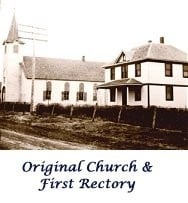 By the fall of 1906, Holy Trinity Parish increased in size to about sixty families who felt they could support a resident pastor. They requested that Fr. Herberichs discuss the matter with Bishop Thomas F. Lillis, who was bishop of the diocese at that time. Permission was granted and Fr. Herberichs was appointed as first resident pastor. A pastor’s house was soon built at a nominal cost.
In 1907 a two-acre cemetery site was purchased 3½ blocks north of the church. Father John Anthony Haefele and a committee of three parishioners named John (John Boehm, John Schweiger and John Baumgartner) were working on this cemetery, which had not been named. On Fr. John’s suggestion, the cemetery was named “St. John’s” after these hard-working committee members.
 In 1909, Fr. Herberichs, owing to illness, went to his homeland of Holland to visit family and regain his health. Fr. A.J. Blaufuss took charge of the parish in his absence. Fr. Herberichs passed away in October 1909.
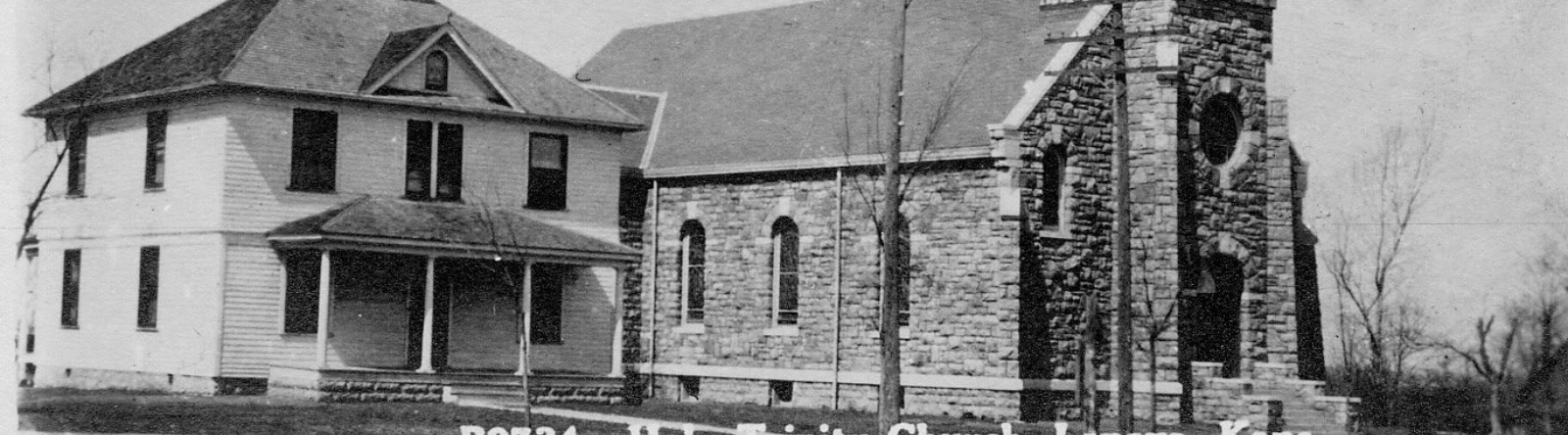
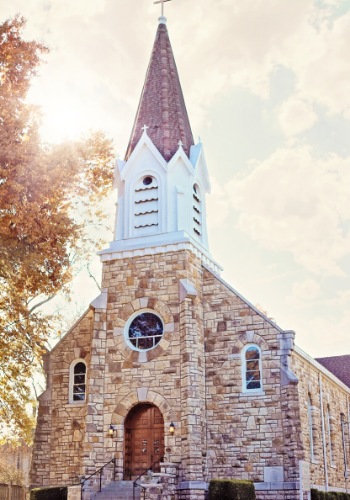
Due to the growth of the parish at this time, the little white frame church was becoming too small. The decision was made to build a stone church in 1910. The excavation work was done by the parishioners in order to keep the cost to a minimum. Max and Mary Ann Zahner donated the stone from a quarry on their farm, which they had established in 1902. The men of the parish used their teams and wagons to haul the rock to the building site. They hauled approximately 2.8 million pounds of rock.
In the spring of 1911, the cornerstone was laid by Bishop John Ward. The church was completed in the fall of 1911 at the cost of $16,000. The interior of the church was not as ornate as it is today; that change came several years later. The new stone church was dedicated by Bishop Ward on Thanksgiving Day of that year. Following the dedication services, a turkey dinner was served to the bishop, visiting clergy and parishioners in the basement of the church.
The Founding and Growth of Holy Trinity School
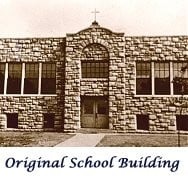 Shortly after the stone church was completed, the growing Holy Trinity parish recognized the need for a school. The original church building, located where the present rectory now stands, was renovated and converted into two classrooms along with living quarters for the Benedictine Sisters from Atchison, Kansas, who would staff the new school.
In the fall of 1912, Sister Lucina and Sister Simplicia became the first teachers at Holy Trinity School, instructing students in grades one through eight. As the parish community continued to expand, the school soon outgrew its modest facilities.
In response, Fr. Haefele and the parishioners made the decision to construct a new stone school building in 1917. Once again, the Zahner family generously donated the stone, and parishioners volunteered much of the labor to reduce construction costs. Fr. Haefele worked alongside his parishioners in the building effort. Fortunately, the parish included many skilled workers—mechanics, carpenters, electricians, and stonemasons—who contributed their expertise to the project. The new school was completed at a cost of $10,000 and featured three classrooms and living quarters for the Sisters.
For a time, Holy Trinity also offered a four-year high school program in addition to elementary grades one through eight. However, declining enrollment led to a reduction in the high school program—first to two years, and eventually to a two-year business course. The business course was later discontinued, as many students chose to remain at home to assist with farm work after completing eighth grade. Meanwhile, enrollment in the elementary school continued to grow steadily year after year.
Parish Growth and Leadership Transitions
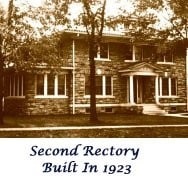 The next major improvement to Holy Trinity Parish was the construction of a stone rectory, which began in 1923 under the leadership of Fr. Haefele. Once again, parishioners contributed both financially and through their labor, helping to keep costs to $14,500. The former parish house was relocated north of the stone school and renovated to serve as a convent for the Benedictine Sisters. Fr. Haefele worked tirelessly alongside the laborers and continually inspired the community with his dedication. However, due to declining health, he was forced to resign as pastor on May 1, 1931.
Fr. E.R. Embleau succeeded Fr. Haefele and brought new energy to the parish, including the formation of the Holy Name Society. A stone garage was added next to the rectory at a cost of $1,200, and the school basement was converted into a fully functional dining hall. Following Fr. Embleau’s passing in 1937, Fr. William Landwehr briefly served as administrator until Fr. John J. O’Keefe was appointed pastor on June 18, 1938.
Parish Life in the 1940s and 1950s
Throughout the 1940s and 1950s, the annual chicken dinner and carnival became the parish’s main fundraising event, drawing large crowds and strengthening community ties. Another cherished tradition was the end-of-the-year school picnic, a festive occasion for families held at the Clarence Schweiger farm near 87th Street.
During his pastorate, Fr. O’Keefe and the parishioners worked diligently to raise funds for a pipe organ. Their efforts were rewarded when the organ was installed and played for the first time during Christmas Mass. Sadly, Fr. O’Keefe became seriously ill and passed away in 1951. In his memory, a shrine to Our Lady of Fatima was erected as a final gift to the parish.
Fr. William O’Shea served as temporary administrator from August 1951 to September 1952. He was succeeded by Fr. Francis Staab, under whose leadership the Mother’s Club was established. In later years, this organization evolved into the Parent-Teacher Organization (P.T.O.), which played a vital role in supporting the school. The group raised funds and fostered community by organizing card parties and social events for parish families.
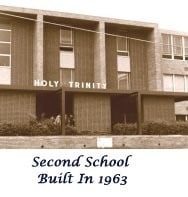
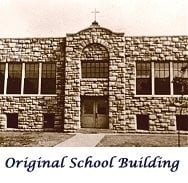 Fr. Paul Miller was successor to Fr. Staab in 1960. At that time, Holy Trinity had outgrown the rock school or “University” as it was fondly called. Under Fr. Miller’s direction and encouragement, a new two-story brick school was constructed and dedicated in 1963.
Fr. Miller was transferred in 1967 and Fr. Quigley became pastor. Under Fr. Quigley’s direction, a new activities building was constructed. This brick building is on the corner of 92nd and Summit Street. In the beginning, it provided housing for the Sisters, upper-grade classrooms for the school, a library and religious education offices. The building was later used for the Holy Trinity Child Care Center and Pre-School.
 Lenexa continued to grow, as did Holy Trinity. In 1968, the boundaries of the parish changed and three hundred families in the eastern and southeastern section of Holy Trinity Parish became a part of the new Holy Cross Parish. By 1970, Lenexa had grown to a population of 5,240 people. In 1973, Holy Trinity underwent another split of the parish boundaries by creating the Good Shepherd Parish to the north.
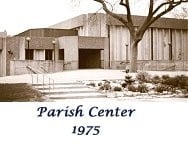
In 1974, the rock school and frame convent were demolished and a “Parish Center” was erected. It was dedicated in 1975. Fr. Quigley died in 1976 while still pastor of Holy Trinity.
 Fr. James F. Wright came to Holy Trinity as pastor in 1977. He was pastor of the parish for eleven years. During his years as pastor, it was very important to Fr. Jim that the children in both Holy Trinity School and its School of Religion have the best religious education possible. In addition to the Sunday Liturgry, he offered many programs for adults to enhance their spiritual lives through parish missions, bible study and speakers.
As Lenexa continued to grow, bringing more Catholics to the parish, it was determined that another split of the parish was needed. In 1979, the parish boundaries once again changed creating the Prince of Peace Parish to the south. Lenexa’s population grew to 19,000 by the end of the decade. From 1980 to 1990, Lenexa had the largest percentage growth in all of Kansas, increasing by 82.6% to a population of 34,034. The once-spacious worship and education quarters gradually became overcrowded. It was determined that yet another split needed to take place and in 1980, Holy Spirit Parish was created to the east and south. Holy Trinity still grew from 1,200 to 1,500 families by 1990.
In 1988, Fr. Raymond Burger became pastor of Holy Trinity. One of Fr. Ray’s important goals for the parish was to nurture the faith life of each parishioner. He offered parish weekend retreats which resulted in the formation of Living Faith Communities. The retreats helped individuals and families strengthen their faith lives and made it possible for them to become an integral part of the larger parish family.
Another important goal of Fr. Burger was to make many needed improvements to the physical condition of the parish. The 1980’s were especially difficult times financially for the parish, so the challenge of making major improvements was great. Nevertheless, Fr. Burger set out to renovate our two churches. The renovation of the “worship center” (now our “Parish Center”) and the Old Stone Chapel took place from 1989 to 1991, at a combined cost of $250,000. Parishioners made special pledges to aid in the task. The result was very well received and seemed to energize the parish community. This set the tone for improvements and additions unparalleled in our 110-year history.
In 1992, a “Master Plan” was formulated by Nick Disidore, then Parish Administrator, that outlined the many areas of need for our growing parish that would lead us into the 21st century. It was presented to Archbishop Ignatius Strecker, who praised the plan for its “depth of vision.” Through several town hall meetings, the plan was presented to the parish and adopted for immediate implementation.
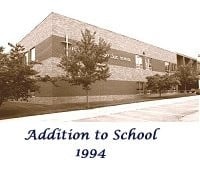
In the fall of 1993, “Phase One” began with the expansion of our grade school, which involved adding 20,000 square feet for 14 classrooms, at a cost of $1.3 million. It was blessed and dedicated by Archbishop James P. Keleher in August 1994. This building was completely paid for when finished.
 In the spring of 1994, preliminary work began on “Phase Two,” which focused on our new church building. During the following 12-month period, the parish sought special multi-year pledges which were tied to memorials. Over 1,000 households made a commitment, allowing construction to begin in the summer of 1995. Four properties (some dating back to the 1910’s) were purchased, which allowed the new church to be built at its present site. The size of the building is 27,100 square feet and it seats 1,200 people.
The stained-glass windows and bell came from Fr. Burger’s boyhood parish of St. Thomas Church in Armourdale, which had been closed for several years. The round painted icon above the altar, all altar furniture and many of the vestments, altar cloths and banners were crafted by parishioners.
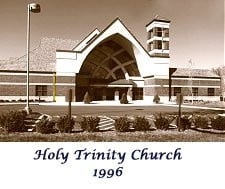 The new church was dedicated on the Feast of the Immaculate Conception in 1996, with a full house in attendance. A reception followed in the social room. The cost to build the church was $3.8 million, plus an additional $800,000 for furnishings and miscellaneous building expenses.
“Phase Three” began in the spring of 1998 and touched nearly every corner of parish life. The first component involved the transition of the former church into what is now our “Parish Center,” complete with hardwood floor, retractable basketball goals and bleachers, kitchen, restrooms and improvements to the roof and lower level. It was completed at a cost of $750,000 and dedicated on September 25, 1998.
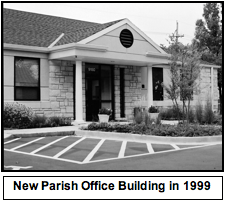 The next component involved the construction of our Administrative Office building. The parish staff was originally housed in the former church; they moved to the top of the Children’s Center once construction began on its renovation in mid-January 1999. This structure, along with a new garage for the rectory, was built on the corner of our campus at 92nd and Pflumm. The Parish Office is 4,000 square feet on the ground level with a 1,500 square-foot basement. It was dedicated on August 18, 1999, at a cost of $700,000.
Other improvements associated with Phase 3 involved the “Children’s Center,” which at the time was home to nearly 250 children throughout the week. New energy-efficient windows were installed in September 1999 along with new carpeting, fresh paint inside and out, restroom renovations and renovation to the upper level for our growing Catechesis of the Good Shepherd ministry, at a cost of about $75,000.
In July 2001, Fr. Ray Burger was reassigned to Holy Family Church in Eudora, after thirteen years as Holy Trinity’s Pastor. Fr. Bob Pflumm, retired priest in residence, transferred to St. Michael’s in Leawood, KS. They were succeeded by Fr. Tom Dolezal, coming from St. Michael’s Parish in Axtell, where he spent 15 years as pastor. Fr. Tom was joined by Fr. Bala Swamy, a missionary priest from India, who stayed for two years until his reassignment to St. Mary’s, KS, in June 2003. Fr. Richard Osei Bempah, a missionary priest from Ghana, was assigned as associate pastor to Holy Trinity in July 2003 for one year.
In April 2005, Fr. Regie Saldanha, a missionary priest from the diocese of New Guinea, where he served for 6 years, joined our staff as Associate Pastor. He was born and raised in India. In 2008 he was installed as a permanent priest for the Archdiocese of Kansas City.
Ground breaking for Phase One was celebrated in 2006 on the Feast of the Immaculate Conception of Mary, the 10 th Anniversary of the dedication of the new church, with participation by various members of the community who would directly benefit from this new facility. Participants included 3- to 5-year-old children from our Early Education Center (complete with small shovels and hardhats), teachers & families from our Catechesis of the Good Shepherd ministry, high school students, young adults, members of parish ministries & organizations and building committee members. A complimentary breakfast was held in the Parish Center for the entire parish.
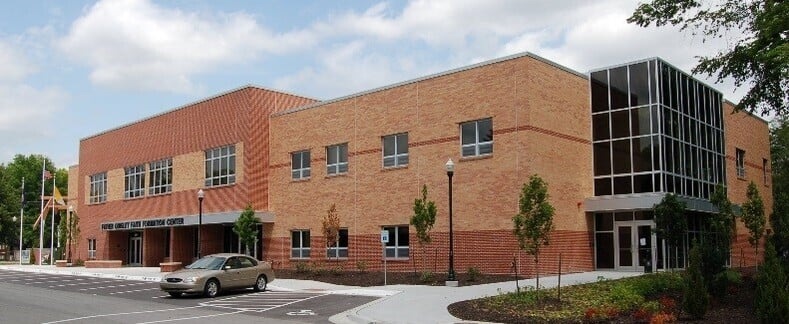 Construction began on the 40,000+ square-foot Fr. Quigley Faith Formation Center in April 2007. The Center was dedicated and blessed by Archbishop Naumann on Saturday, May 17, 2008. During the dedication, crucifixes for the various rooms and spaces were blessed and placed on the walls of the new facility.
Upon completion of the new Center, the former Children’s Center building, which was built in 1967 and was also home to the Catechesis of the Good Shepherd program, was torn down to make way for the second half of Phase One, the Perpetual Adoration Chapel. Before tearing down the building, the Lenexa Fire and Police forces used it to practice various life safety and protection training exercises for several weeks. After the Saturday morning Mass on Memorial Day weekend, Fr. Tom held a “de-commissioning” prayer service for many members who had worked at the facility and saw it as part of our landscape for 40+ years.
In October 2008, Fr. Regie was reassigned to serve as pastor of three small parishes in Miami County. With his departure, Fr. Richard McDonald was assigned to assist as a transition until formal assignments in June 2009.
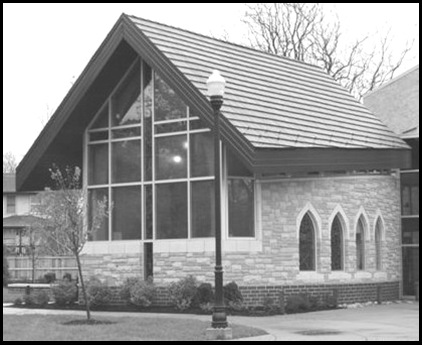 The new Perpetual Adoration Chapel, on the north end of the Fr. Quigley Center, is located at the center of our parish “campus” by design, since the Eucharist is central to our faith. It features seating for 40 patrons, eight custom-built stained-glass windows featuring the seven corporal works of mercy and a Eucharistic theme, a large stained-glass cross on the front wall, stations of the cross, electric votive candles, statues, 24/7 access and dedicated parking on the north. Members of the parish built the chapel furnishings. The altar and stand and holy water font were built from oak wood salvaged from the former Worship Center altar (1975) and stained-glass window trim (still visible from outside the Parish Center.) The pews were completely refurbished after being donated by Holy Spirit parish in Overland Park as they had purchased new pews when remodeling their sanctuary. A small meditation garden is located on the east side of the chapel, named in honor of former pastor Fr. Jim Wright, who enjoyed gardening.
The chapel was dedicated on Thanksgiving Sunday, November 30, 2008, after the 11:30 am Mass. An open house was held and a complimentary lunch was served to parishioners in the large banquet hall on the top level of the Fr. Quigley Faith Formation Center. The total construction cost for Phase One was $5,784,000 with soft costs (including the purchase of homes/property and the demolition of the old Activity Building) bringing the entire cost to just over $7,000,000.
On May 23, 2009, Holy Trinity hosted the ordination of three new priests for the Archdiocese, including Patrick Sullivan, who spent several summers assisting the parish as a seminarian. When assignments were announced in June 2009, Fr. Patrick was selected to serve Holy Trinity as his first assignment; he was reassigned in October 2010 to serve as pastor of three small rural parishes.
In the summer of 2009, Fr. Richard left for a sabbatical in Rome. He returned in October 2009 and assisted until July 2010 when he was reassigned to St. Peter’s Cathedral.
In August, 2009, after further discernment, construction began on school additions and renovations. Located on the south side of the Parish Center and east of the grade school, the new addition would connect the separate school buildings under "one roof." The new administrative offices, computer lab and media center onened on Feb. 22, 2011 and three new all-day Kindergarten classrooms opened in August 2011. Grade school students assembled wooden crosses made of oak wood harvested from the large trees that had to be removed from the construction site and had them blessed by Fr. Francis Bakyor. The crosses were made available to parishioners as a way to thank them for their support.
Mr. Gary Lammers, HT school principal for 14 years and lifelong school administrator within our Archdiocese, retired at the end of June 2010. After an extensive search was conducted by the Search Committee, Mrs. Martha Concannon was chosen to lead the school and Mrs. Lisa Blaes, long-tenured teacher at Holy Trinity, was appointed as the new Associate Principal starting Fall 2010.
The Christ Renews His Parish program began at Holy Trinity in Fall 2010. Through cost-free weekend retreats held on the HT campus each fall and spring (separately for men & women) CRHP renews and strengthen personal faith in Jesus and promotes a closer parish community where faith is lived out more fully through service to the parish, marriages are enriched and family faith is strengthened. As of 2016, 559 parishioners had experienced weekend retreats (12 women's and 11 men's teams) with 413 completing an additional period of deeper spiritual enrichment.
In November 2010, Holy Trinity began celebrating Mass in Spanish to serve a growing Hispanic Catholic community in our area. These Masses were held in the Stone Chapel on Saturdays at 6:00 pm; the first one had over 200 in attendance. The Stone Chapel is shared with members of the Korean Catholic Community in the area, who have been the primary tenants since 1998.
In late November 2010, Fr. Francis Bakyor from Ghana was assigned here along with Fr. Mike Stubbs, who was coming off a sabbatical in the Holy Land. Fr. Stubbs, who is a scripture scholar and writer for the Leaven newspaper, departed in July 2011 when he was assigned as pastor to Holy Cross.
On April 9, 2011, at St. Michael the Archangel Church, we celebrated the ordination of three Holy Trinity parishioners as part of the first class of seventeen Permanent Deacons ordained within the Archdiocese of KCK. They were Stuart Holland, Dana Nearmyer and Tom Mulvenon. Stuart was assigned to serve Holy Trinity while Tom was assigned to St. Joseph Parish in Shawnee. Dana was initally assigned to St. James Academy and Holy Trinity, and later was assigned to the Archdiocese as director of its evangelization program.
In June 2011, after serving as Pastor of Holy Trinity for ten years, Fr. Tom announced that he would be stepping down due to health reasons. As a way to show their appreciation for his many years of service, parishioners were invited to make a contribution to our Parish endowment fund. Nearly $19,000 in gifts were given in his honor.
In July 2011, Fr. Mike Koller was announced as our new pastor. He was joined by new associate pastor Fr. Barry Clayton, who was ordained on May 28, 2011, right here at Holy Trinity. Father Clayton and Father Bakyor both received new assignments in July 2013. Fr. Clayton was appointed pastor of parishes in Sebetha, Fidelity and Wetmore; Fr. Bakyor was appointed parochial administrator for parishes in Wathena, Troy and Bendena.
In July 2013, Fr. Scott Wallisch came to Holy Trinity as a Priest in Residence. Frs. Vince Huber and Edward Ahn were assigned to Holy Tinity in July 2013 as Associate Pastors. Frs. Vince & Edward came from The Apostles of the Interior Life, a religious community that was founded in Rome by Fr. Salvatore Scorza for the essential mission of spiritual formation.
Father Scott departed on July 31, 2014 after being assigned to the St. Lawrence Center. Gerard Alba was ordained a transitional deacon on May 17, 2014 and assigned to Holy Trinity on June 14, 2014. After being ordained as a priest for the Archdiocese on Nov.15, 2014, Father Gerard began his ministry as an Associate Pastor here at Holy Trinity.
In September 2014, Holy Trinity made available to its parishioners an online faith formation program called Formed. At formed.org, parishioners have online access to a wealth of the best Catholic content currently available. This includes video series, feature-length movies, audio content and e-books. New content is always being added.
A pastoral plan for ministry for Hispanics in Johnson County was approved by Archbisop Naumann in June, 2015. Three parish-based Centers for Hispanic Ministry were established: St. Paul in Olathe, Holy Cross in Overland Park, and Good Shepherd in Shawnee. In line with this change, the Spanish Mass at Holy Trinity was discontinued in July 2015.
Through prayer and discernment, Holy Trinity began a partnership in 2015 with the Fraternity of the Poor of Jesus Christ, a Roman Catholic Apostolic Instititute composed of religious sisters, brothers, priests and lay associates who "live with the poor, as the poor and for the poor." Through the generous support of our parishioners, we support our "Brazilian Sisters" in many ways; providing sack lunches for their street ministry, meals for the Sisters, holiday support, Bible studies, arts & crafts, and work around the convent. In June 2015, our Knights of Columbus renovated the Sisters' kitchen and installed a new hot water tank. Our 2015 Lenten Appeal collected over $24,000 that was used for a variety of needs, including a new roof for their convent.
In September 2015 a new, interactive, multi-media men's program began at Holy Trinity called That Man is You! It focuses on the development of authentic male leaders over the course of three years. The program successfully considers men in their relationship to God, their spouses and their children - it's about transforming lives. Approximately one hundred men from the parish participate in TMIY each fall and spring session.
Another new program began in 2015 called ChristLife. This program shared in the very mission of Christ; dealings with how we may infuse a culture of evangelization into all of our efforts. The first phase (Discovering Christ) was held in Spring 2016 with 55 regular attendees, and a second round was held in the Fall of 2016. The second phase (Following Christ) took place in January 2017 with the final phase (Sharing Christ) following in April of 2017.
Father Edward Ahn was reassigned to the faculty of Kenrick-Glennon Seminary in St. Louis as spiritual director for the seminarians in June, 2016. This is one of the seminaries where men from our Archdiocese are preparing for the priesthood. Father Ahn visits our parish frequently on his free weekends and celebrates mass with us.
Mrs. Martha Concannon, Holy Trinity School Principal since Fall 2010, left to pursue other opportunities at the end of the 2015-16 school year. Following an extensive search, Mr. Scott Merfen was chosen to lead the school starting Fall 2016.
Steve Lemmons, Holy Trinity parishioner and adminsitrator for Good Shepherd Parish, became a deacon through the Archdiocesan diaconate program. His ordination was held on June 3, 2017. Steve serves the Archdiocese as needed, and in 2021 he took over as coordinater of Holy Trinity's Marriage Ministry.
In 1880, twenty Catholic families requested permission to form a parish in rural Lenexa, Kansas. The request was granted and Holy Trinity Parish was formed. Thanks to the faith and perseverance of our early parishioners, a Catholic school was added and over the years, the campus has grown to meet the needs of an ever-changing parish and community.
Today, nearly 140 years since its inception, Holy Trinity Catholic Church remains a beacon in the Johnson County area. Our campus consists of a beautiful main church, a historic Stone Chapel, the largest Catholic grade school in the Archdiocese, a rectory that has housed our beloved priests for more than 100 years, modern administrative offices for clergy and staff, and a 24/7 Adoration Chapel. It also includes our two-story Father Quigley Faith Formation Center, which houses our Catechesis of the Good Shepherd Program, our Early Education program, and meeting rooms. We are indeed richly blessed.
 Several very sucessful capital campaigns were held during the twenty year span when most of the construction on campus was performed. But despite these sucesses, in 2016 Holy Trinity found itself with an outstanding debt of $3.9 million, with $150,000 in interest payments annually. At that time parish leadership, with the input from the congregation, decided to attempt another capital campaign but with a different approach: more parishioner involvement and a specific goal of "Imagine the Possibities" of what Holy Trinity could do to support its parish ministries and the community with the interest it paid on its building loan.
The "Imagine the Possibilities Campaign" was kicked off in June, 2017. Thanks to commitments from over 750 Holy Trinity families, the building debt balance was paid off on July 31, 2020. The Parish was finally debt free!