


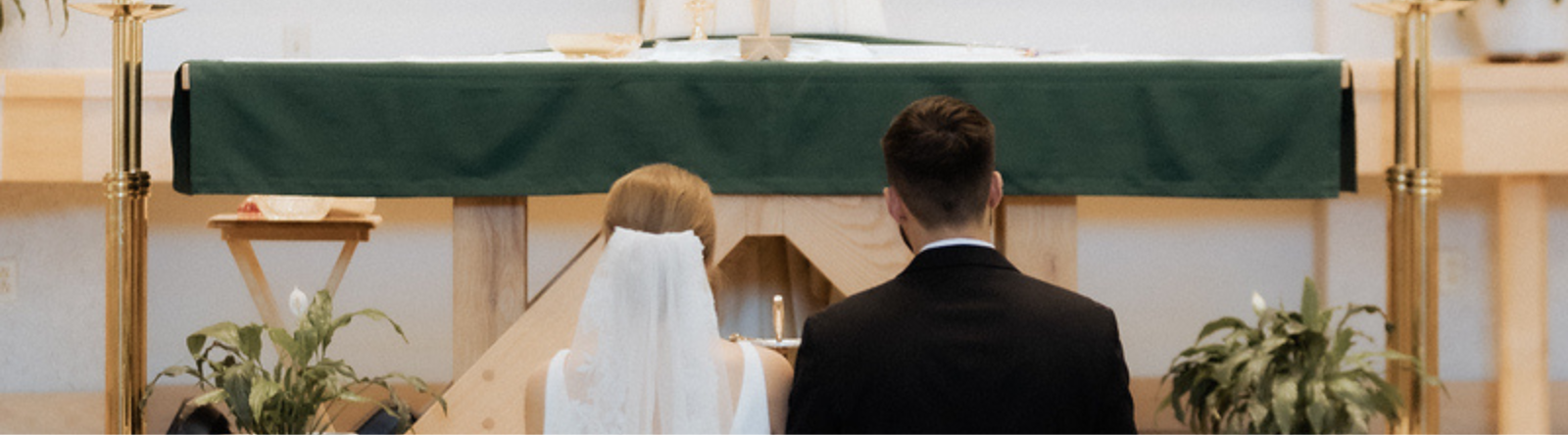
Congratulations on Your Upcoming Wedding Here at Holy Trinity!
The Church provides many wonderful resources for guiding your wedding music choices. These include:
- the revised Order of Celebrating Matrimony or “OCM” (1990, 2015, 2016)
- the U.S. Bishops’ document, "Sing to the Lord: Music in Divine Worship" or “STL” (2007)
- "General Instruction of the Roman Missal" or “GIRM” (2010)
Downloadable documents below include:
- Wedding Music Planning Process - 2026 (page 17 from the Marriage Prep Guidebook June 2026)
- WEDDING WITHIN MASS MUSIC PLANNING FORM
- WEDDING OUTSIDE MASS MUSIC PLANNING FORM
AFTER YOU HAVE DOWNLOADED, PRINTED, AND READ THE PROCEDURES AND PLANNING DOCUMENTS,
please review the pages below for musical suggestions suitable for the various parts of a Catholic wedding liturgy.
Your Wedding Music
Prelude Music (includes Seating of the Families)
Pre-service music begins approximately 15 minutes before the ceremony. The organist will choose appropriate instrumental prelude music unless a special request is made. An approved vocal solo may also serve as a portion of the Prelude music and/or during the seating of grandparents/parents (one or two solos total). See Presentation/Preparation of Gifts, below, for suggestions.
Entrance Procession - First Form
The revised Order of Celebrating Matrimony (OCM) envisions the music sung by the congregation as the most important music at the wedding (just as at Sunday Mass): “The procession to the altar takes place in the customary manner. Meanwhile the Entrance Chant takes place.” (OCM 46, STL 222a). "Its purpose is to open the celebration, foster the unity of those who have been gathered, introduce their thoughts to the mystery of the liturgical time or festivity, and accompany the procession of the Priest and ministers." (GIRM 47) A well-chosen familiar hymn (tune) common to several traditions can help to bind this temporary community together in its purpose of worshiping God and witnessing your marriage covenant. Click on the links to hear the music:
- Praise to the Lord, the Almighty (LOBE DEN HERREN)
- This Is a Miracle Moment (John Thornburg/LOBE DEN HERREN)
- Joyful, Joyful, We Adore You (HYMN TO JOY)
- God of Love, Embrace Your People (James Chepponis/HYMN TO JOY; words also fit HYFRYDOL)
- Love Divine, All Loves Excelling (HYFRYDOL)
- Love Has Brought Us Here Together (Mary Louise Bringle/HYFRYDOL; words also fit HYMN TO JOY)
- Hear Us Now, Our God and Father (Huxold, Newton/HYFRYDOL; words also fit HYMN TO JOY)
- O God beyond All Praising (THAXTED) - verses 1 and 3
Entrance Procession - Second Form
Instrumental music may accompany the procession if it seems more suitable in deference to those attending (OCM 49, 50). Both experience and theological reflection suggest that it is preferable to choose one piece of music for the whole procession (including the entrance of the clergy, groom, wedding attendants, and the bride) and that the desired dramatic effect of the bride entering is best served when the music communicates the culmination of a single procession rather than two separate events. However, if two pieces of music are desired here - the first one for the wedding attendants, and the second one for the bride and groom (or bride) - the selections below are labeled W for the whole procession, 1 for the wedding attendants, and 2 for the bride or bride and groom, to indicate their appropriate uses.
- (1) Air from Water Music- Handel, arr. Bish
- (1) Aria “Be Thou Near Me”- J.S. Bach, arr. Johnson
- (1) Arioso- J.S. Bach
- (W) Largo from Winter- Vivaldi
- (W 1) Canon in D-Pachelbel
- (W 1 2) St. Anthony Chorale- Haydn
- (W 1 2) Prelude from Te Deum- Charpentier
- (W 1 2) Processional of Joy- Beethoven, arr. Hopson
- (W 1 2) Rigaudon, Campra
- (W 1 2) The Prince of Denmark’s March- Clarke (sometimes called Trumpet Voluntary- Purcell)
- (W 1 2) Trumpet Tune in D Major- David N. Johnson
Opening Hymn (optional)
"If instrumental music accompanies the Entrance Procession, an Opening/Gathering hymn may be sung once all are in place." (OCM 50, STL 222b)
This option is particularly appropriate at weddings taking place outside of Mass, giving those gathered another opportunity to participate. Please refer to the list of Entrance Hymns above.
Gloria (new in 2010, within Mass only)
A musical setting of the Gloria that is locally familiar, and that invites all gathered to sing a short repetitive refrain with the cantor singing the verses, is the most hospitable and effective for weddings, due to the musical and sometimes religious diversity diversity of those gathered.
Responsorial Psalm
A responsorial psalm is sung by the cantor after the First Reading, with the congregation singing a brief response. Please choose a psalm from among those listed in the scripture section of your marriage preparation planning guide (33, 34, 103, 112, 128, 145, or 148). Then the music director will offer options for an appropriate musical setting.
Alleluia and Verse
The Alleluia and Verse (familiar parish setting) are sung by the cantor and the congregation before the Gospel reading.
Celebrating Matrimony: Acclamation after the Reception of Consent
"After the priest receives the couples’ consent, he invites a response from the congregation" (OCM 65), saying, “Let us bless the Lord.” All may say “Thanks be to God” or sing a short acclamation of praise and thanksgiving to God. The word "Alleluia" literally means "praise God". At Holy Trinity, we have found that repeating the same "Alleluia" (once only) that was sung before the Gospel reading is the best way (presently) to support a sung response if the couple chooses that option.
Celebrating Matrimony: Hymn/Canticle of Praise after the Giving of Rings (optional)
After the exchange of rings, “a hymn or canticle of praise may be sung by the whole community”. (OCM 68)
- God, in the Planning, Bell/SLANE - verses 1 and 4
- Hear Us Now, Our God and Father Huxold, Newton verses 1 and 3 (HYFRYDOL; words also fit HYMN TO JOY)
- God of Love, Embrace Your People, Chepponis/HYMN TO JOY (words also fit HYFRYDOL) - all verses
Alternatively, this may also be an appropriate time for couples to present flowers in honor of and in prayer to the Blessed Mother and/or the Holy Family, accompanied by a hymn or canticle of praise sung by the whole community.
- Mary, First Among Believers, Delores Dufner, OSB (1, 3, 5)
- My Soul Proclaims Your Greatness (Canticle of Mary)
- Hail Mary, Gentle Woman
- Salve Regina
- Sing of Mary, Pure and Lowly
- Immaculate Mary
- Would You Bless Our Homes and Families (no listening link; ask for text)
Presentation/Preparation of Gifts (Mass only - congregational songs)
- Love Is the Sunlight, Borghild Jacobson/BUNESSAN
- Lord of All Hopefulness, Struther/SLANE
- God, in the Planning, Bell/SLANE
- The Servant Song, Gillard
- When Love Is Found, Wren/O WALY WALY
- Hear Us Now, Our God and Father/HYFRYDOL (words also fit HYMN TO JOY)
Presentation/Preparation of Gifts (Mass only - vocal solos)
“Vocalists may sing alone during the Preparation of the Gifts or after Communion.” (STL 221)
- When Love Is Found (Brian Wren)
- God, in the Planning, Bell/ SLANE
- Not for Tongues of Heaven’s Angels, Dudley-Smith; Joncas
- Love Is the Sunlight, Borghild Jacobson/ BUNESSAN
- Set Me As a Seal, Paul Melley
- The Gift of Love (Hal H. Hopson)
- Walk with Them, Lord (Don Besig)
Presentation/Preparation of Gifts (Mass only - instrumental music)
Instrumental music may also be appropriate in order to balance the amount and use of sung music elsewhere in the liturgy.
Holy, Mystery of Faith, Amen, Lamb of God (Mass only)
A musically unified, locally known Mass setting in English (e.g., the same setting as the Gloria) is the most conducive to “full, conscious, active” congregational participation.
Distribution of Holy Communion (Mass only)
The purpose of the Communion chant is “to express the spiritual union of the communicants by means of the unity of their voices . . . and to bring out more clearly the ‘communitarian’ character of the procession to receive the Eucharist.” (GIRM 86) “Because the Communion chant expresses the unity of those processing and receiving the Holy Sacrament, communal singing is commendable. The singing of the people should be preeminent.” (STL 189) “Vocalists may sing alone . . . after Communion. Soloists should not usurp parts of the Mass designated for congregational participation.” (STL 221)
Instrumental recessional music follows the Final Blessing and (often, although not required) the Introduction of the Couple.
- Allegretto from Spring- Vivaldi, arr. Wolff
- Hornpipe (Allegro Maestoso) from Water Music- Handel, arr. Johnson
- Hymn to Joy- Beethoven, Stanley; arr. Burkhardt
- La Rejouissance from Royal Fireworks Music- Handel, arr. Wolff
- Processional of Joy- Beethoven, arr. Hopson
- Rondeau- Mouret, arr. Thompson
- Trumpet Tune- Purcell
Vocal samples of our parish wedding cantors are available by clicking on the links below:
- Becky - Love Divine (NETTLETON)
- Celeste - Love Divine (BEACH SPRING)
- Emily - Love Divine (HYFRYDOL)
- Marcia - Love Divine (HYMN TO JOY)
Once you have worked through the above information, a personal wedding music consultation with our parish Music Director, Joe Heron, is required for reviewing and finalizing your music choices. To schedule this appointment, please contact Joe.
We hope that you find the information on these pages helpful in your wedding planning process. Our warmest wishes to you as you embark upon this exciting journey in your lives together!